
The Red Treasure of the Mediterranean
If there is one product that truly embodies the essence of Catalan and Mediterranean gastronomy, it is, without any doubt, the Palamos prawn. This internationally renowned
crustacean has long transcended the borders of the Costa Brava to conquer the tables of the
world’s finest restaurants, becoming a recognisable symbol of the maritime and culinary tradition of the province of Girona. Its brilliant red colour, which dazzles the eye even before the first bite, its unmistakable sea-fresh aroma, and that flavour which combines the natural sweetness of the ocean with an intensity and depth that few Mediterranean species can match, make it a delicacy of the highest order, cherished both by the most demanding palates and by any genuine lover of fine food. In the following pages, we explore in detail everything you need to know about this extraordinary product: its history, the geographical and biological characteristics that make it unique, how it is caught while respecting the ecosystem, the best ways to cook it, and above all, where to experience it at its very finest along the Costa Brava.
What the Palamos Prawn is and what makes it different from the rest
The Palamos prawn, whose scientific name is Aristeus antennatus, belongs to the family of red
prawns of the western Mediterranean, but it must not be confused with other varieties fished
along different stretches of the Spanish and Italian coastline. What sets it apart in such a radical
way, and grants it the status of a benchmark gourmet product, is not merely its geographical
origin, but the combination of environmental, biological and handling factors that come together in a truly unrepeatable way in the waters off the Costa Brava. To begin with, it lives and develops in an extraordinarily rich submarine habitat: a rocky, rugged seabed full of canyons, slopes and vertical walls, at depths ranging from 300 to 700 metres, with an average of around 400 metres. In that high-pressure environment, with scarce light and consistently low temperatures, the prawn feeds on the diverse marine fauna and flora that proliferate in the seabed sediments: algae, small crustaceans, minerals and organic matter of remarkable nutritional richness. This specific diet,
which no farm or aquaculture system can artificially replicate, is precisely what gives the Palamos prawn its sweet, deep and yet delicate flavour that distinguishes it from any other prawn in the Mediterranean. Its texture, moreover, is firm yet meltingly soft at the same time, with a flesh that dissolves on the palate leaving a long, persistent aftertaste that tasters describe as iodine-rich, sweet and mineral. A product that speaks directly of the ecosystem that produces it.
The Fonera Canyon: the underwater geography that explains everything
To truly understand why the Palamos prawn is what it is, one must descend — at least in the
imagination — to the seabed off the Costa Brava and look into the Fonera Canyon. This impressive submarine valley stretches some 50 kilometres in length and reaches a maximum
depth of nearly 2,000 metres. It begins just three nautical miles from Cape Sant Sebastia and
extends into the Mediterranean, creating an ecosystem of extraordinary biodiversity. Its vertical walls and jagged ridges generate cold, nutrient-rich currents that constantly fertilise the seabed, encouraging the proliferation of the animal and plant species on which the red prawn feeds. The most productive fishing grounds lie precisely along these walls, on slopes of up to 35 degrees, where the trawling nets of the local fleet find the richest catches. The increasingly precise
positioning technology used today by the Palamos fleet allows fishermen to identify the
highest-concentration zones with great accuracy, minimising environmental impact and optimising
every trip out to sea. This submarine canyon is not merely a geographical feature; it is, literally,
the reason for the existence of the Palamos prawn. Without it, without its currents, its sediments and its unique biodiversity, this crustacean would simply be another prawn. With it, it becomes an unrepeatable product.
A history born less than a century ago
It may come as a surprise that a product so widely celebrated and so deeply woven into the
gastronomic identity of Catalonia has, in fact, a relatively short history. The Palamos prawn is not
an age-old delicacy: it was discovered and began to be fished systematically less than a hundred
years ago, as the result of a specific and well-documented episode that historians place in the
year 1930. That year, a group of fishermen from l’Ametlla de Mar, a town on the southern Catalan
coast where trawl fishing had already been practised successfully for several years, arrived at the port of Palamos and introduced the local sailors to this technique, which consists of dragging a net along the seabed and capturing whatever lies in its path. It was then that the fishermen of Palamos discovered that in the submarine canyons off their coast lived, in great abundance, a remarkable red prawn that had until that moment remained completely unknown to them. What followed was a story of gradual success: from the sea to the kitchens of the fishermen’s homes, from there to the town’s restaurants, and from those to the markets of Barcelona and the rest of Catalonia. The commercial boom came in the 1950s and 1960s, when the product began to earn its reputation in the most demanding gastronomic circles. However, it was not until the great revolution of Spanish and Catalan haute cuisine at the end of the 20th century, with chefs of the calibre of Ferran Adria and Joan Roca leading the way, that the Palamos prawn definitively achieved the status of an internationally recognised gourmet product, which it holds today with full
justification.
The fishing: early mornings, trawling, fish market and auction
The day of a prawn fisherman in Palamos begins before dawn. The vessels of the local fleet —
nine boats with quality certification for most of the year, rising to as many as 35 during the peak
season from May to July — leave the harbour in the darkness of the early morning and head for
the fishing grounds of the Fonera Canyon, several miles offshore. Once there, the trawling nets
are deployed and left to work for hours along the seabed. By mid-afternoon, with the catch on board, the boats begin the return to port. It is at that moment that one of the most authentic and
exciting spectacles on the entire Costa Brava begins: the auction at the Palamos Fish Market,
open to the public and now an attraction in its own right. Restaurateurs, wholesalers and private
buyers bid in real time for lots of freshly arrived prawns, classified into four sizes — small,
medium, large and extra-large — according to the criteria of the fishermen themselves. The finest
prawns, the largest and most flawless in appearance, reach prices that accurately reflect their status as a luxury product. All this fishing activity generates between three and five million euros annually for the Palamos Fishermen’s Brotherhood, and total catches amount to between 120 and 170 tonnes per year. From the fish market, the prawns travel swiftly to restaurants and markets across Spain and around the world: gourmet shops in Europe, Asia and the Americas regularly receive this product, always accompanied by the quality seal that follows it from the port.
Sustainability: Palamos’s commitment to the sea
Trawl fishing, while it is the technique that allowed the great fishing grounds of the Fonera Canyon to be discovered and remains the only efficient way to catch red prawns at those depths, has a significant impact on the seabed. The fishermen of Palamos have been aware of this for decades and have been pioneers in establishing sustainable management measures that today serve as a reference for other fleets in the Mediterranean. The most important of these is the mandatoryclose d season: from January to March, for two full months, no vessel belonging to the brotherhood may practise trawling, allowing the seabed to rest, recover naturally, and the prawn populations to rebuild and consolidate. Added to this are other measures such as strict control of the number of certified vessels, the implementation of increasingly precise positioning technology to minimise impact on sensitive areas, and the active participation of the brotherhood in scientific monitoring programmes that track the health of the fishing grounds. The result is that the Palamos prawn is not only a product of exceptional gastronomic quality, but also an example of how artisanal and sustainable fishing can coexist with commercial exploitation when there is collective will and responsible regulation. Eating a Palamos prawn is, in that sense, an act that goes beyond immediate pleasure: it is a vote in favour of a model of relating to the sea that deserves to be
preserved.
The quality seal: a guarantee of origin and authenticity
In a market where confusion and imitation are commonplace, and where it is not unusual for
prawns of very diverse origins to be sold under names that evoke quality without substantiating it, the Palamos prawn has a clear and verifiable protection mechanism: the quality brand seal
awarded by the Palamos Fishermen’s Brotherhood itself. This seal guarantees the consumer not only the geographical origin of the product — fished exclusively in the Fonera Canyon grounds by certified vessels of the local fleet — but also that it has been caught and handled in accordance with the sustainability and quality standards established by the brotherhood. Only specimens that
meet all these requirements may carry the official label, making that small mark a genuine
guarantee of authenticity. For any consumer seeking the real Palamos prawn rather than an imitation, identifying this seal is the essential first step. Restaurants that offer certified Palamos
prawns are making a clear commitment to quality and traceability, and that commitment deserves
to be recognised and valued by diners.
How to cook the Palamos prawn: simplicity as the guiding principle
When working with a product of the exceptional quality of the Palamos prawn, the main
temptation to resist is that of complicating its preparation unnecessarily. The finest chefs who
have had the opportunity to work with it — from Joan Roca of El Celler de Can Roca to Quique
Dacosta, who works with the Mediterranean cousin from Denia — all agree that the greatest
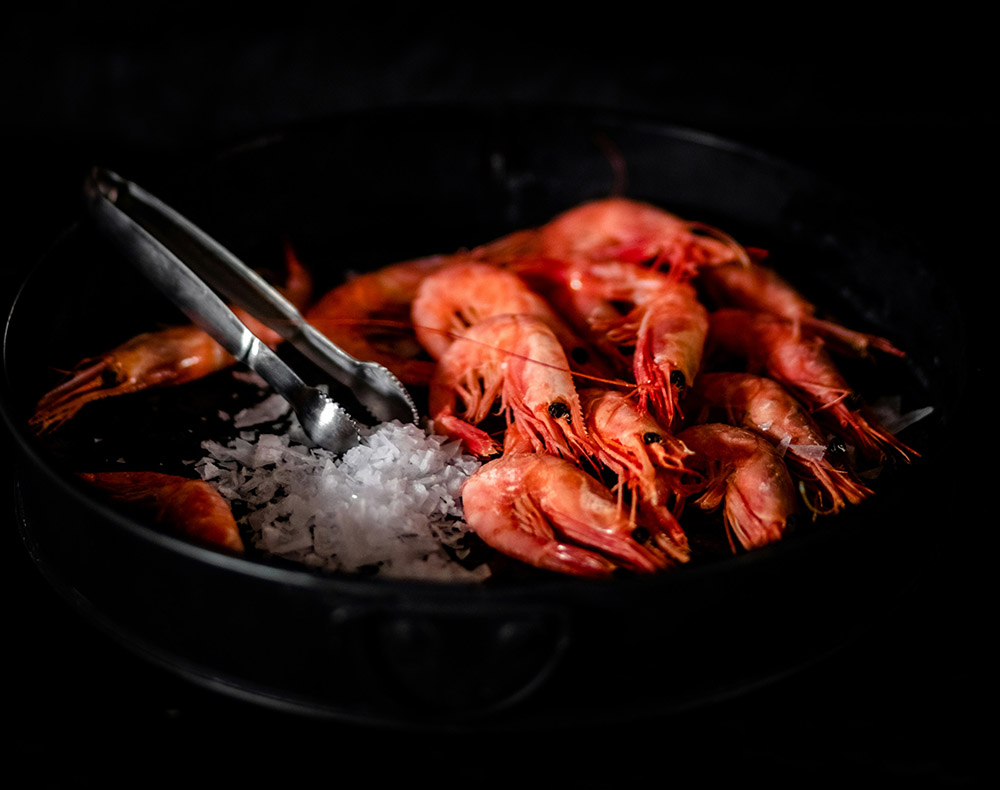
honour one can pay this crustacean is to let it speak for itself, intervening as little as possible. The griddle is therefore the supreme preparation, preferred both by the fishermen of Palamos and by the most sophisticated cooks: fresh prawns, just arrived from the auction, cooked on a very hot griddle for no more than a few minutes, with a pinch of coarse sea salt, are simply perfect. The
flesh comes out firm on the outside and juicy within, and the head holds all that concentrated,
iodine-rich, deep broth which is, for many, the very best part of the whole crustacean. Indeed, the ritual of sucking the head with devotion to extract its essence is a tradition so deeply rooted in Palamos that the Menu de la Gamba offered each year by the restaurants of the bay carries the expressive Catalan motto ‘Xucla’n el cap i llepa-te’n els dits’ — suck the head and lick your
fingers. Beyond the griddle, the Palamos prawn lends itself to other preparations that haute
cuisine has explored with brilliant results: the traditional fisherman’s suquet stew, tartare with
citrus notes, prawn bisque as a base for other dishes, soupy rice in which the prawn’s
concentrated stock forms the soul of the dish, or even more avant-garde preparations such as
raw prawn carpaccio, Mediterranean-style ceviche, or infusions made from toasted prawn heads. In every case, the common denominator is the same: the Palamos prawn transforms any dish into something truly memorable.
The season and the gastronomic events of the year
Although the Palamos prawn is available virtually year-round — with the exception of the closed
season from January to March — its peak gastronomic season runs from May to July, when
catches are most abundant, the product is at its flavour peak and the atmosphere at Palamos
harbour takes on a special intensity. It is during those months that the restaurants of the Bay of
Palamos — covering the municipalities of Palamos, Calonge, Sant Antoni and Baix llobregat — launch the famous Menu de la Gamba, a coordinated gastronomic initiative in which all
participating establishments offer at the same price a full menu centred on this crustacean: bread with tomato and anchovies, a medium-sized Palamos prawn from the griddle, noodles with aioli, dessert, wine and coffee. It is a way of making the prawn accessible to all budgets while
collectively celebrating the most emblematic product of the area. In April, the annual Festa de la Gamba de Palamos takes place, a gastronomic festival that attracts thousands of visitors and
combines tastings prepared by renowned chefs, cooking workshops, exhibitions on the fishing
tradition, family activities and the opportunity to attend the fish market auction. In October, the Palamos Gastronomic Days broaden the focus to encompass the full range of local gastronomy.
For those wishing to delve deeper into the culture surrounding this product, the Palamos Fishing
Museum offers a comprehensive and fascinating account of the town’s maritime history, from
traditional techniques to the challenges of the present day.
Where to enjoy the authentic Palamos prawn: Hotel Trias
To experience the Palamos prawn in its full dimension — its flavour, its freshness, its history and the incomparable setting in which it is born — one needs to find the right place to enjoy it. And few options bring together so many favourable elements as Hotel Trias in Palamos, one of the most iconic and respected establishments on the entire Costa Brava. Set in a privileged position
overlooking the bay, Hotel Trias is far more than a place to stay: it is a local institution with
decades of history and a genuine commitment to local gastronomy, to the producers of the
territory and to the culinary culture of this land. Its gastronomic offering places at the centre
precisely what deserves to be at the centre: fresh, local, seasonal seafood, with the Palamos
prawn as the star. The kitchen at Hotel Trias works directly with the port’s fish market, ensuring that the prawns that reach the table are from that very morning, freshly auctioned, with no unnecessary intermediaries that might compromise the product’s freshness. The signature preparation is, naturally, the griddle: Palamos prawns served at the precise point of cooking, with all their juices intact and that generous head which invites the ritual of extracting its essence — a combination of reverence and greediness that only the finest products are capable of provoking.
But the menu at Hotel Trias also explores other dimensions of this crustacean: traditional
marinero suquets, rice dishes in which the prawn lends all its power to the broth, and other
preparations that always respect the identity of the product without subordinating it to
unnecessarily complex techniques. To sit in the dining room of Hotel Trias, with views over the
open Mediterranean and a plate of Palamos prawns just in from the port, is an experience that
condenses into a single moment everything that makes the gastronomy of the Costa Brava truly
great: the sea, the tradition, the product and the care with which it is handled. There is no better
way to understand why the Palamos prawn is what it is.
A gastronomic heritage with its eyes on the future
The Palamos prawn has travelled an extraordinary road in less than a century: from being an
unknown creature in the depths of the Fonera Canyon to becoming one of the most sought-after and celebrated products in all of Mediterranean gastronomy. That journey would not have been possible without the sustained effort of several generations of fishermen who put out to sea before daybreak, without the vision of the restaurateurs who chose to work with quality local produce rather than opting for the convenience of conventional supply chains, and without the attention that Catalan and Spanish haute cuisine paid to this crustacean at the moment when the gastronomic revolution of the late 20th century placed local, seasonal ingredients at the heart of fine dining. Today, the Palamos prawn faces the future with a combination of pride and responsibility. The pride of being a unique, unrepeatable product, with its own quality seal and international recognition. And the responsibility of preserving the ecosystem that makes it possible, of continuing to champion sustainable and regulated fishing, and of passing on to new generations of fishermen, cooks and consumers an appreciation of what they have in their hands.
Palamos and the Costa Brava have built around this prawn a cultural and gastronomic ecosystem
— festivals, museums, set menus, tourism experiences — that makes the region an unmissable destination for any lover of fine food. The Palamos prawn is not just a product: it is a story, a landscape, a community and a way of understanding the relationship between human beings and the sea. All of that fits in a single bite.
Hotel Trias · Palamos · Costa Brava · Girona · Catalonia — Peak season: May to July